Introduction
What is time? We experience it as a river, carrying us from a past we can no longer touch to a future that never quite arrives. Yet what if this feeling of flow is the grandest of illusions? The Advaita Vedānta tradition has long held this to be so: time belongs to Māyā, the realm of appearances, not to Brahman, the timeless ground of reality.
This ancient insight no longer stands alone. On the frontiers of thought, where philosophy and physics meet, our deepest assumptions about time are beginning to fracture. By starting from our most direct experience and integrating the wisdom of tradition, we can arrive at a simple but radical conclusion:
Time is not fundamental. It is a local phenomenon, an organizing principle within consciousness. Each Now is self-contained, complete, and meaningful.
And this reframing gives us a new picture: Instead of a universe evolving over time, it is the expansion of the whole through, within, and as every individual experience.
The Self-Contained Now
Look around. Now close your eyes. Open them again. Do you really know that the world you see now is the same one you saw before? All you actually have is this moment’s content: your memory of what seemed to be there before, your present perceptions, and your expectations of what might come next. Continuity is inferred, not given.
Philosophers across cultures have noticed the same thing. Augustine spoke of “three presents”: the present of past (memory), the present of present (attention), and the present of future (expectation). William James described the “specious present”, the stretch of awareness that feels like one moment but already contains traces of before and after. Zen master Dōgen went further: being is time. Each moment is not a fragment, but the whole of existence disclosed at once.
These observations all converge on the same idea: each Now is self-contained, a complete experience in its own right. Past and future exist only as structures within the Now, not outside it. We do not live in a stream of time. We live in Nows that carry memory and anticipation inside themselves.
But if a Now is complete, what makes it one thing rather than a heap of sensations?
Patterns Are Experiences
What makes a Now one thing? Philosophers call it the unity of experience. This unity arises because a Now is a pattern, and a pattern is itself an experience. A pattern isn’t a lifeless arrangement of parts that causes an experience; the pattern is the very structure of the experience. A pattern is a set of relationships, and the holistic grasping of those relationships is what we mean by experience. The two are inseparable.
This is not a metaphor but a structural claim about reality. The clearest illustrations come from psychology, where the mind actively unifies a simple arrangement into a rich, holistic event.
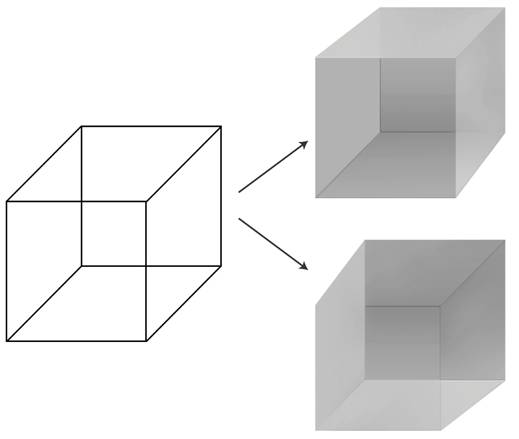
Consider the Necker Cube, an optical figure made of twelve simple lines. No one experiences it as a collection of lines. What you see is a single, unified, three-dimensional cube that can flip orientation in your mind. You don’t perceive the lines first and then infer the cube; the experience just is the pattern grasped as a cube. Pattern and unified experience are one event.
The same principle appears in language. When you read a sentence, you don’t experience a crawl of letters. You experience an instantaneous “flash of meaning.” The thought is not caused by the words; it is the pattern of words apprehended as a whole.
Philosophers like William James and Alfred North Whitehead argued that reality is fundamentally made not of inert matter, but of such “experiential occasions”, unified events that cohere into patterns of meaning.
This is what each Now is. It is not a thin slice of a timeline containing disconnected objects. Each Now is a fundamental unit of reality: a coherent pattern-experience that feels unified, textured, and complete. Each Now expands the whole.
Physics Reinterpreted: Laws as Geometry of Nows
Physics is often taken as obvious proof that time is real and fundamental. But when you look closely, the picture is very different.
Einstein’s theory of relativity showed that there is no universal present. Each observer has their own slicing of events which depends on motion and gravity. Time is not absolute; it is relative to context. The search for an even deeper theory, quantum gravity, takes this revolutionary idea a step further. Some approaches, such as the Wheeler–DeWitt framework or the “thermal time” hypothesis, explore models in which the most basic description of the universe is time-free, with temporal order emerging only in certain conditions. While other theories still treat time as a parameter, these proposals suggest that the timelessness hinted at by relativity may reach all the way down to the foundations. Taken together, they show that physics can be read in more than one way. What follows is an idealist interpretation of those possibilities.
What, then, are the laws of physics describing? Not a flowing narrative of the universe “evolving” in time, but the invariant geometry of possible states: which Nows can exist and how they cohere with one another.
To connect these Nows, we rely on clocks. But a clock is not an external metronome; it is a subsystem of the universe whose states change in a monotonic, stable, and decoupled way. The swing of a pendulum, the oscillation of an atom, and the orbit of the Earth around the Sun each provides a local index by which we label other processes. This is a crucial point: there is no master clock outside the system. We can only ever measure change within the universe by comparing one part of it to another. Time, therefore, is revealed to be a purely internal and relational measurement, not an external, absolute background.
This reinterpretation explains why physics works with such extraordinary precision without appealing to a cosmic flow of time. Kepler’s third law of planetary motion states that the square of a planet’s orbital period is always proportional to the cube of its distance from the Sun. Put simply: if you know how far a planet is from the Sun, you can know exactly how long its orbit will take. This law expresses a structural relationship within the system itself. It doesn’t require a universal ticking clock, only the relational geometry of the orbit. For centuries, astronomers even defined time by such orbital regularities, in what they called ephemeris time, before transitioning to more refined relativistic standards. Relativity deepens the point: “proper time” is nothing more than the accumulated readings of a local clock carried along its path through spacetime.
One puzzle often raised is the thermodynamic arrow of time: why do we always see entropy increase, never decrease? Standard physics explains this by positing that the universe began in an extraordinarily ordered state, and the growth of disorder has been unfolding ever since. This account shows that irreversibility comes from an asymmetry in physical states, not from a literal flow of time itself. From the perspective of coherent Nows, this arrow is not a sign of a flowing timeline but a structural asymmetry in the geometry itself. Each Now carries traces (records, memories, imprints) that align with the direction from lower to higher entropy. This asymmetry in the web of Nows is what gives us both the physical irreversibility we see in the world and the experiential sense of moving from past to future.
So the lesson is clear: physics does not describe a film unfolding in time; it maps the geometry of coherent Nows. Time, in the equations, is nothing more than a parameterization, the numbering of these Nows by a chosen clock.
And this raises the most personal and pressing question of all: if the fundamental reality described by physics is a timeless geometry, why do we experience an undeniable and powerful flow of time? The answer, it turns out, lies not in the world, but in the structure of consciousness itself.
Why Time Seems to Flow
Physics points to a timeless geometry. Yet our lives feel steeped in time. We age, we remember, we anticipate. The flow of time is among the most powerful features of our experience. How can we reconcile the two?
The answer is that the flow is not in the world but in consciousness itself. Each Now contains three layers:
- Memory: traces of what came before, held as if they still exist.
- Perception: the vivid present, the focus of awareness.
- Anticipation: expectations and projections of what might come next.
Together, these give the illusion of motion through time. But in truth, all of them are structures inside the present moment. Augustine called them the “three presents”; Edmund Husserl described the same structure as retention, impression, protention.
To give this inner experience of sequence a consistent pace, consciousness also anchors itself to a clock subsystem. This could be the rhythm of breath, the heartbeat, the rising and setting of the sun. By binding memory and anticipation to a stable rhythm, the mind constructs a sequence, a narrative flow. Without such anchors, time feels distorted or even absent, as in dreams, deep meditation, or moments of shock.
This explains both the power and the variability of time’s flow. In ordinary life, the heartbeat and circadian cycles provide a steady beat. In altered states, these anchors loosen, and the flow of time can stretch, collapse, or vanish altogether. What feels like a single vivid instant in a car accident may contain an immense richness of detail. What feels like hours in a dream may occur in seconds of clock time.
So, the powerful sensation of time’s flow does not reflect a fundamental truth about the world. It is the feeling of living within a story that our minds constantly tell. It’s a story crafted from the materials of memory,
perception, anticipation, and the rhythm of an internal clock. Time’s river runs only in experience, and only because our minds trace it out.
Traditions in Alignment
This tension between timeless reality and the lived flow of time is not new. Philosophers and spiritual traditions have wrestled with it for millennia, often arriving at remarkably similar insights through very different paths.
One major stream of thought sees a timeless reality behind the illusion of time. In Advaita Vedānta, Śaṅkara taught that Brahman, the ultimate reality, is changeless, while time belongs only to Māyā, the realm of appearance. Gauḍapāda went further: there is no real origination at all, no true becoming. In the West, Augustine echoed a similar theme: God exists in an eternal present, while our sense of past and future reflects the limitations of the human mind.
Another path arrives at the same conclusion by focusing on the radical nature of the present. Buddhism treats continuity as a mental overlay on discrete, momentary events. Zen master Dōgen gave this its most radical form: being-time (Uji) means each moment is not a slice of reality but the complete expression of reality itself.
While these perspectives converge on time’s non-fundamental nature, their flavors differ. Vedānta and Augustine point to a timeless ground beyond appearances, while Buddhism and Zen highlight the present itself as the fullness of reality. Taken together, they outline two complementary ways to reach the same summit: time is not the bedrock of reality but a local appearance within it.
Meaning Inside the Illusion
If time and continuity are illusions, does that mean our lives have no meaning? This is the deepest fear that arises when time is dethroned. After all, so much of what drives us is tied to continuity: striving to become a better version of ourselves, working for a future we may never see, hoping to leave a legacy that endures beyond us. If continuity is a construct, why should any of this matter?
The answer is that meaning has never truly depended on continuity. It arises instead from the fundamental rhythm of consciousness itself, which has two primary motions: expansion and integration. Consciousness is inherently creative, always generating new patterns, thoughts, and possibilities (expansion). It is also inherently aware, capable of taking in, harmonizing, and finding coherence in its creations (integration). These two motions together form the deep structure of how reality is experienced.
Consider the simple act of learning a new skill, say, cooking a recipe or playing a song on an instrument. The initial clumsiness, the effort to stretch beyond what you already know, is expansion. The moment the pieces click together, when you move smoothly and taste the result or hear the music come alive, is integration. The satisfaction of that moment is meaning revealed. It isn’t dependent on someday becoming a chef or a concert pianist; it is intrinsic to the creative dance happening in the Now.
When expansion and integration are both present, a moment feels meaningful. The creative potential of the Now is expressed, and its fruits are absorbed. When one is missing, meaning drains away: endless expansion leads to chaos; endless integration to stagnation.
Traditions across cultures echo this point in their own languages. Vedānta insists that the illusory world is the necessary medium (expansion) through which the timeless absolute is realized and known (integration). Buddhism teaches that from the emptiness of a fixed self comes the freedom for boundless compassion (expansion) that functions perfectly in the world (integration). Zen says each moment is complete, and wholehearted presence in it is enough, an elegant balance of the two.
So the “illusion” of time does not rob life of purpose. It clarifies where purpose has always lived: in the richness of each Now, as it expands the whole through the dance of creation and integration.
Beyond Chronology
If time is local, we’re not limited to arranging experience along a single timeline. We can organize the Now by non-temporal structures. These are other geometries of “closeness” that are often more faithful to lived reality.
Intrinsic proximity: identity and emotion. By chronology, childhood is “far.” But if a five-year-old moment still shapes who you are, it’s near in the geometry of identity. Emotional weight works the same way: a trauma can remain present for decades; an anticipated birth or exam can press into today. These are not stretches of time; they are structural nearness in the pattern of the self.
Shared rhythms: culture and embodiment. Communities coordinate life with cycles: harvests, prayers, festivals. They do this not to measure duration but to shape attention and organize meaning. The body offers similar rhythms: breath and heartbeat. Focusing on breath in meditation doesn’t “tell time”; it retunes experience to a living cadence that isn’t a timeline at all.
Re-patterning the Now: art and therapy. Artists routinely abandon chronology, starting at the end or braiding past and future, to reveal truer wholes. Therapists help people reorder memories by significance, not sequence, so old events can resolve here. In both cases, rearranging relations among memories, emotions, and meanings re-patterns the Now, transforming its felt quality without appealing to “before” and “after.”
Once time is seen as local, chronology becomes optional. It’s just one possible coordinate among many. Identity relevance, emotional salience, shared rhythms, and creative re-patterning are alternative orderings that disclose different, sometimes deeper, structures of reality. Far from distorting experience, they let the Now show more of what it is.
Expansive Cosmology
Step back now and take in the picture. The traditions remind us that time is not ultimate. Physics shows that the universe can be described without it. Experience itself reveals the Now as self-contained, unified, and complete.
What emerges is a new vision: Instead of a universe evolving over time, it is the expansion of the whole through, within, and as every individual experience.
Each Now is not a fragment in a timeline but a fundamental unit of reality, a coherent actual occasion that stands complete in itself. And each Now adds to the richness of the whole. The world does not move forward in time; it grows outward in meaning. This expansion is the continuous actualization of new patterns within the infinite potential of reality. Each unique Now is a novel region of this timeless possibility made real. Reality doesn’t get older; it becomes richer, more diverse, and more self-aware with every life lived.
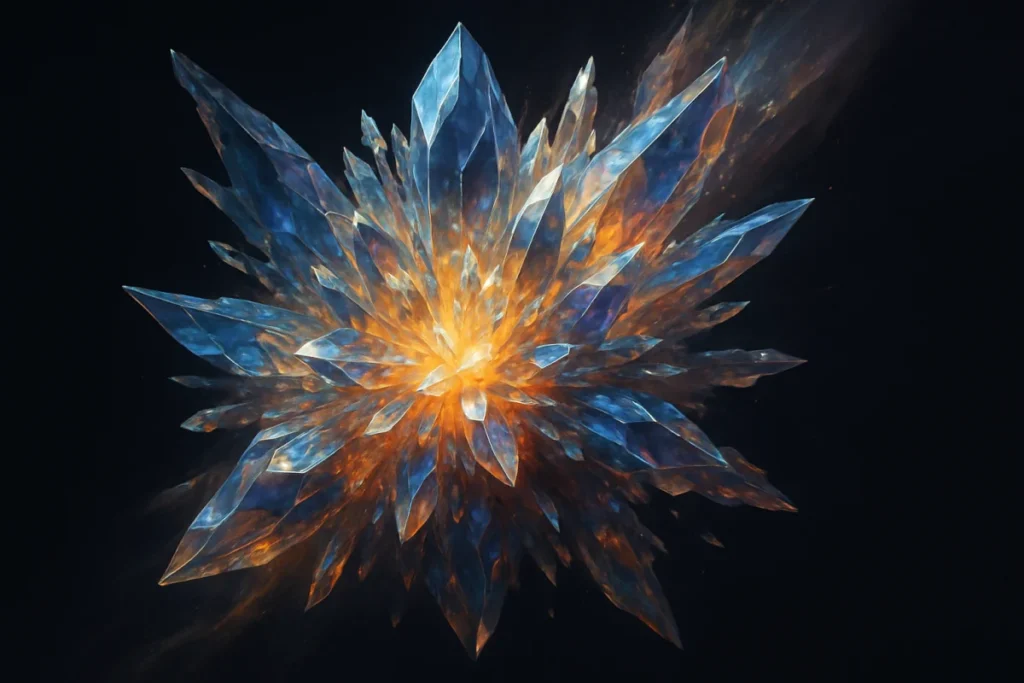
This is why the crystal image is so apt. A crystal does not “flow forward” in time; it grows by accreting new facets in a particular direction of increasing complexity. In the same way, the geometry of Nows expands outward, with entropy providing the asymmetry that orients the growth without requiring a background clock.
Perhaps the best way to picture this cosmology is not as a river flowing, but as a vast crystal growing. Each Now, each experience, is a new facet forming on its surface. No facet erases or replaces the others; each adds its brilliance to the whole. Seen from any angle, the jewel becomes more intricate, more complex, more radiant. The universe is not a story being told from beginning to end; it is a jewel of infinite possibility, continuously forming.
This is where meaning lives. Not in continuity, not in some projected future self, but in the actualization of creative potential here and now. Every perception, every thought, every act of love or insight is more than personal. It is a new facet on the crystal of reality.
What began as a puzzle about time resolves into a cosmology: reality does not unfold; it expands. And the expansion happens through us, as us, in every experience we live.
Conclusion: Time as Local, Idealist Science at Work
We began with a puzzle: time seems to flow, yet Vedānta calls it illusion, and modern physics suggests it may not exist at the most fundamental level. The methodology of idealist science starts from experience, reframes physics, integrates the insights of traditions, and builds a positive vision. Applying this method reveals a new picture.
- Each Now is self-contained: a unity of experience that carries memory and anticipation within itself.
- A pattern is itself an experience: pattern and realization are two sides of the same coin.
- Physics describes the geometry of coherent Nows, not a film playing across a universal clock.
- Traditions converge: some pointing to a timeless ground beyond appearances, others to the fullness of the present itself.
- Meaning does not depend on continuity; it arises from the rhythm of expansion and integration within each Now.
- Once time is seen as local, new orderings of experience become possible: identity, emotion, rhythm, creativity. Each of these opens ways to live more richly.
- The whole vision resolves in an expansive cosmology: reality does not unfold in time, it expands through every experience.
This is the promise of idealist science: not to erase what matters to us, but to place it on firmer, deeper ground. Time is local, but meaning is immediate. The continuity we crave is not in a linear future but in the richness of every Now, each one adding a new facet to the crystal of reality.
Though this vision is metaphysical, it suggests empirical avenues too: altered states of consciousness, memory encoding, and entropy all hint at how the ‘geometry of Nows’ might be explored scientifically.
So the next time you pause, close your eyes, and open them again, remember: this Now is not just a passing instant. It is a fundamental unit of reality, a complete experience, a new expansion of the whole.
Reality does not get older; it gets richer. And it does so through us, in every moment we live.